The Global Exposome Forum (GEF) is a coalition of organizations and individuals working toward the same goals – advancing new research, capacity and network building, and facilitating institutional support to ensure a future informed by exposomics.
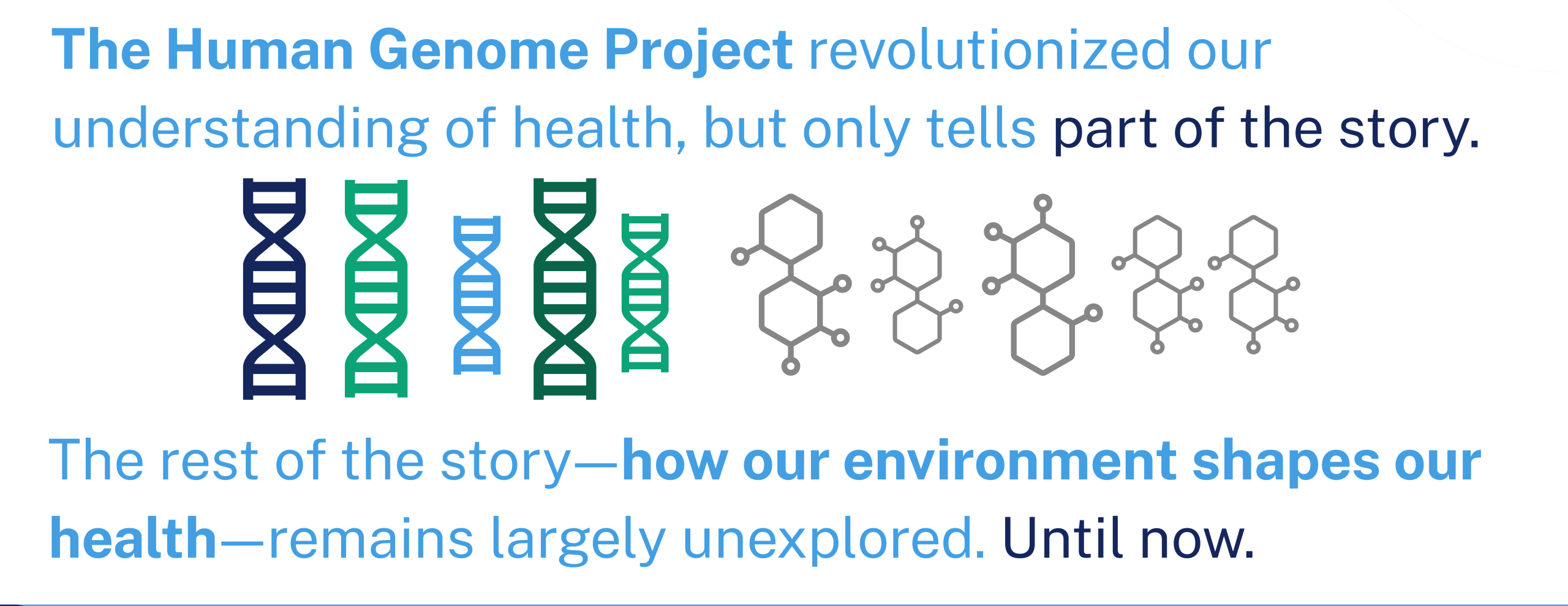
Did you know that 90% of chronic disease is linked to environmental exposures?
We’re launching an unprecedented scientific endeavour to map the combined impact of all environmental factors that affect human health from conception to death.
What We Achieved at the
Exposome Moonshot Forum

Project Roadmap
A manifest towards a Human Exposome Project based on actionable and targeted next steps, future targets, and immediate interventions. The sum total of which will merge to facilitate a future informed by and responsive to the incredible insights only the Human Exposome can offer.

Engagement of key governmental partners and stakeholders close alignment with US health agency-wide priorities as articulated by Nicole Kleinstreuer, Acting NIH Deputy Director for Program Coordination, Planning, and Strategic Initiatives.
Clearly outlined conceptual framework, technical innovations needed, and practical first steps to facilitate collaboration around key themes and needs. Working groups are now in the process of being designed and launched to offered sustained systems for collaboration.
The Bordeaux Symposium will convene leading scientists and trainees dedicated to advancing the integration of environmental exposures into research on Alzheimer’s Disease and Related Dementias (AD/ADRD). Drawing on a global network of researchers with complementary expertise in exposomics, data science, and neurodegenerative disease, the meeting provides a powerful foundation for discovery. …
Building upon the success of the Exposome Moonshot Forum, the 2026 Summit will follow a similar yet enhanced format, combining in-depth keynote presentations by leading experts with interactive breakout sessions designed to bridge scientific insight with real-world application. These sessions will provide participants with practical tools and strategies to contextualize, …
Scientists at the Joint Research Centre (JRC) carry out research in various fields to provide independent advice to EU policymakers and put science at the heart of European policies. Originally established under the Euratom Treaty, the JRC has longstanding expertise in the nuclear field, but offers scientific competences from a wide range of disciplines to support almost all EU policy areas.
We work closely with research and policy organisations in EU countries, European institutions and agencies, and scientific partners in Europe and worldwide. Our core strengths are anticipation – providing the scientific underpinning for future policy initiatives; integration – linking scientific and policy areas as no single area can provide answers to today’s complex challenges; and impact – assisting policymakers to track and assess the impact of their policies
The National Institute of Environmental Health Sciences (NIEHS) is expanding and accelerating its contributions to scientific knowledge of human health and the environment, and to the health and well-being of people everywhere.
The Fonds de recherche du Québec (FRQ) is a Quebec government agency whose mission is to support the strategic and coherent development of scientific research in Quebec in the sectors of natural sciences and engineering, health sciences, social sciences and humanities, arts and literature.
The Fonds de recherche du Québec was established on June 1st, 2024, in accordance with the Act to amend the Act respecting the Minister of Economy and Innovation on research in Québec with regard to research.
Health and Environment Response Agency, HERA, is a Lebanese non-governmental organization that focuses on the health and well-being of individuals and the environment surrounding them.
HERA concentrates on the effects of natural and anthropogenic pollutants and their effect on the health of individuals, especially vulnerable communities in the MENA region. Its main goal is to assess the human health risk of environmental exposures, communicate about the risk, and promote healthy living in a clean environment.
The DailyBreath mobile app helps you to manage your risk of experiencing symptoms associated with environmental triggers. Because, ultimately, it’s about the Air YOU Breathe and YOUR Health. The benefits of the DailyBreath app include:
Reduce and avoid symptoms by understanding the allergens, pollutants, and weather conditions that impact YOUR health.
Track your symptoms as associated with environmental triggers to translate your experience of symptoms into your own personalized daily environmental health risk forecast, your DailyBreath Forecast with your own daily Perry (PEHRI) Score.
Pinpoint where in your community you and other DailyBreath users are experiencing acute symptoms triggered due to allergen or pollutant exposures.
Share your journey and experience of the air you breathe with others through community features; the DailyBreath Discussion Board.
Reduce Impact by Implementing Allergen and Pollutant Reduction Interventions, solutions available via our affiliate partners.
The Barcelona Institute for Global Health, ISGlobal, is the fruit of an innovative alliance between the “la Caixa” Foundation, academic institutions and government bodies to contribute to the efforts undertaken by the international community to address the challenges in global health.
ISGlobal is a consolidated hub of excellence in researchthat has grown out of work first started in the world of health care by the Hospital Clínic and the Parc de Salut MAR and in the academic sphere by the University of Barcelona and Pompeu Fabra University. Its working model is based on the generation of scientific knowledgethrough Research Programmes and Groups, and itstranslation through the areas of Education and Training and Analysis and Global Development.
Its ultimate goal is to help close the gaps in health disparities between and within different regions of the world.
MyExposome, Inc. focuses on innovative technologies for monitoring individual environmental exposure with passive monitoring devices. We are an early stage start-up company based in Pennsylvania and Oregon.
Many of our product offerings are currently available under non-disclosure with special licensing terms for high-impact trials and tests.
The United Nations Educational, Scientific and Cultural Organization(UNESCO) is a specialized agency dedicated to strengthening our shared humanity through the promotion of education, science, culture, and communication.
We set standards, produce tools and develop knowledge to create solutions to some of the greatest challenges of our time, and foster a world of greater equality and peace.
Protecting biodiversity, responding to artificial intelligence, advancing quality education, safeguarding heritage, and ensuring access to reliable information are some examples of the work that UNESCO does with its 194 Member States across the globe.
The Human Cell Atlas is a global consortium that is mapping every cell type in the human body, creating a 3-dimensional Atlas of human cells to transform our understanding of biology and disease. The Atlas is likely to lead to major advances in the way illnesses are diagnosed and treated.
Global scientists are building the initial draft of the Human Cell Atlas, organized and championed by the 18 HCA Biological Networks, which include the lung, heart, liver, and immune system, as well as the four HCA Regional Networks: Asia, Middle East, Africa, and Latin America.
An open global initiative, the Human Cell Atlas Consortium was founded in 2016 and has grown to more than 3,900 HCA members, from over 1,700 institutes and more than 100 countries around the world.
EIRENE (European InfrastRucturE for humaN Exposome) is a pan-European research infrastructure dedicated to understanding how environmental exposures influence human health. Its mission is to provide integrated services, harmonized data, and advanced technologies to support large-scale, systematic exposome research, enabling evidence-based policies, prevention strategies, and innovation in precision medicine. The EIRENE consortium currently involves over 50 institutions from 21 European countries, the USA, and Australia, with plans to expand to Canada, Japan, and other regions worldwide.
The National Institute on Aging (NIA), part of the National Institutes of Health (NIH), was established in 1974 to improve the health and well-being of older adults through research. NIA conducts and supports genetic, biological, clinical, behavioral, social, and economic research on aging and the challenges and needs of older adults. NIA is at the forefront of scientific discovery about the nature of healthy aging to extend the healthy, active years of life. It is also the lead federal agency for Alzheimer’s disease and related dementias research.
Created by the U.S. Congress in 1950, the National Institute of Neurological Disorders and Stroke (NINDS) has occupied a central position in the world of neuroscience for nearly 75 years.
The mission of NINDS is to seek fundamental knowledge about the brain and nervous system and to use that knowledge to reduce the burden of neurological disease for all people.
To accomplish this goal, the institute supports and performs basic, translational, and clinical research on the brain and nervous system; fosters the training and career development of investigators in the basic and clinical neurosciences; seeks better understanding, diagnosis, treatment, and prevention of neurological disorders; and disseminates scientific discoveries to the public, health professionals, researchers, and policymakers.
The International Network for Governmental Science Advice (INGSA) is a collaborative platform for policy exchange, capacity building, and research across diverse global science advisory organisations and national systems. Through workshops, conferences and a growing catalogue of tools and guidance, the network aims to enhance the global knowledge-to-policy interface to improve the potential for evidence-informed policy formation at sub-national, national and transnational levels.
The International Human Exposome Network (IHEN) project aims to build a world-wide network to collaborate and improve human exposome research. The network will bring together researchers, policymakers, and independent experts to enhance the impact of future studies in this field.
The European Human Exposome Network launched in 2020 to study the impact of environmental exposures on human health and will run until 2025. The network addresses issues such as exposure to air quality, noise, chemicals and urbanisation, with each project tackling different elements of exposome research.
EHEN’s results will contribute to advancing the European Green Deal’s ambition to protect citizens’ health from pollution and environmental deterioration by providing new evidence for better preventative policies.
The NEXUS (Network for EXposomics in the United States) is a Center for Exposome Research Coordination (CERC). We are supported by the National Institutes of Health under grant number U24ES036819.
The center aims to serve the broad biomedical research community by orchestrating the advancement and promotion of exposome research.