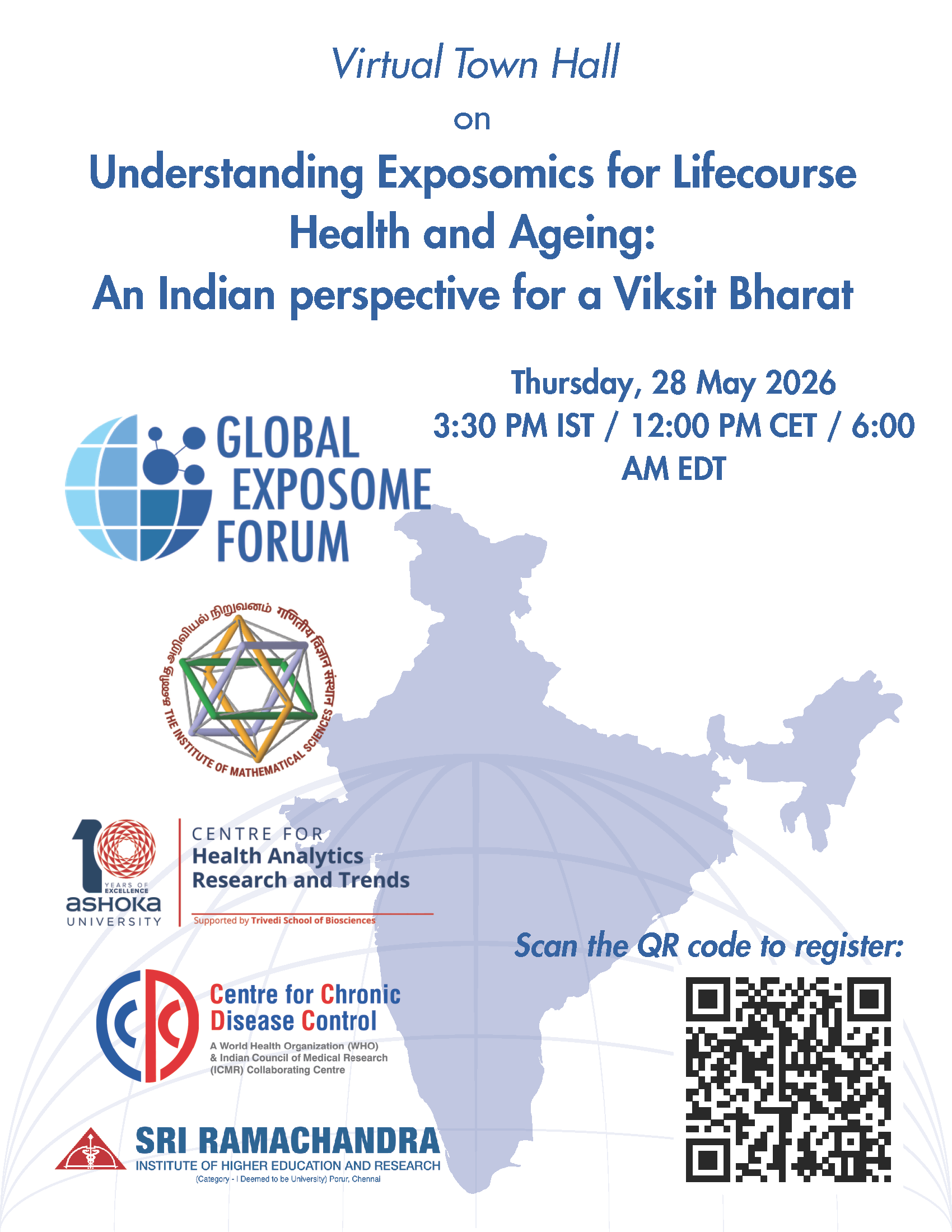
On May 28, 2026, the Global Exposome Forum (GEF) hosted its first regionally organized virtual town hall session in partnership with the newly forming Global Exposome Forum India Chapter. This milestone event marks a significant step in expanding the reach of exposomics research and practice across international borders.
GEF is unique in that it functions as both a grassroots coalition and facilitating body composed of international organizations working within the field of exposomics. Unlike traditional single-entity organizations, GEF brings together diverse stakeholders to advance the science and application of exposome research globally. As part of GEF’s charter and organizational mission, members of the Executive Committee actively support, advise, and facilitate the successful formation of regional chapters, ensuring that local contexts and priorities are meaningfully integrated into the global exposomics network.
As part of this commitment to regional development, GEF leadership co-facilitated the India Chapter Town Hall, which drew more than 200 registrants from across the country and internationally. The event organized by featured presentations by notable leaders in India’s healthcare and research space, including Dr. Soumya Swaminathan and Dr. Anurag Agrawal. These distinguished speakers brought critical perspectives on India’s public health landscape and the potential role of exposomics in addressing the country’s unique health challenges.
The session also featured international perspectives from leading experts in the field. Dr. Gary Miller of Columbia University’s Mailman School of Public Health and Director of the Network for Exposomics in the US provided insights into the evolution and current state of exposomics research in North America. Dr. Poornima Prabhakaran of Ashoka University and the Centre for Chronic Disaese Control with Dr. Kalpana Balakrishnan of the Sri Ramachandra Institute of Higher Education and Research provided a snapshot of current exposomics research including expertise on innovative methodological approaches while also directing the conversation toward ethical considerations in exposome research. Together, these presentations considered both the practical aspects of conducting exposomics research and the specific health priorities that an India Regional Chapter could be uniquely positioned to consider and address, including air pollution, occupational exposures, urbanization impacts, and the complex interplay of environmental and social determinants of health in the Indian context.
Following the formal presentations, the session concluded with an interactive panel discussion – moderated by Dr. Fenna Sillé representing the Global Exposome Forum and Dr. AreejitSamal of the Institute of Mathematical Sciences – during which US-based and India-based experts including Dr. Rima Habre, Dr. Chirag Patel, Dr. Shinjini Bhatnagar, Dr. Prabhakaran Dorairaj and Dr. Vinay Nandcoori exchanged ideas and generated new insights into how to design and implement region-specific exposome projects. Each panelist brought their expertise on various subdisciplines either within exposure science or relevant to the field. This dialogue proved particularly valuable in identifying opportunities for collaboration, discussing methodological adaptations for different contexts, and exploring funding mechanisms and partnership models that could support India-focused exposomics initiatives.
To conclude the town hall, attendees had the privilege of hearing from K. VijayRaghavan, former Principal Scientific Advisor to the government of India. His talk considered a viable path forward for exposomics from the vantage point of cellular and molecular biology. Specifically, he spoke directly to the question of data interpretability and policy development. Here, he directed his consideration to pace of data collection vs. data interpretability highlight AI as a driving force here, making the case for AI a valuable tool for its ability to extract hypothesis from preexisting data.
Reflecting on the virtual town hall meeting, local organizer Dr. Poornima Prabhakaran, Director, Centre for Health Analytics Research & Trends, Ashoka University said: “This virtual meeting provided a launchpad for important dialogues in exposomics research for the region and India in particular. Current resources including cohort studies, exposure assessment models and frameworks for data harmonization clearly demonstrate that India is poised to provide nuanced regional insights to the Global human exposome initiative even as we refine our approach learning from global best practice in the science of exposomics.”
The event represented an exciting and productive first step in forming an GEF India chapter of the Global Exposome Forum. As an official chapter of GEF, the regional leaders will benefit from access to digital infrastructure for communication and collaboration, ongoing advising on organizational best practices and chapter governance, and inclusion in the growing network of international exposomics organizations and initiatives. This support structure is designed to enable the GEF India chapter to establish a strong foundation while maintaining the flexibility to address region-specific priorities and opportunities.
For those who were unable to attend the live town hall meeting, a full recording of the session has been posted to the Global Exposome Forum’s ‘Resources’ page on the official website or see below. The recording serves as both a resource for those interested in the India Chapter’s formation and as a model for other regions considering the establishment of their own GEF chapters.